


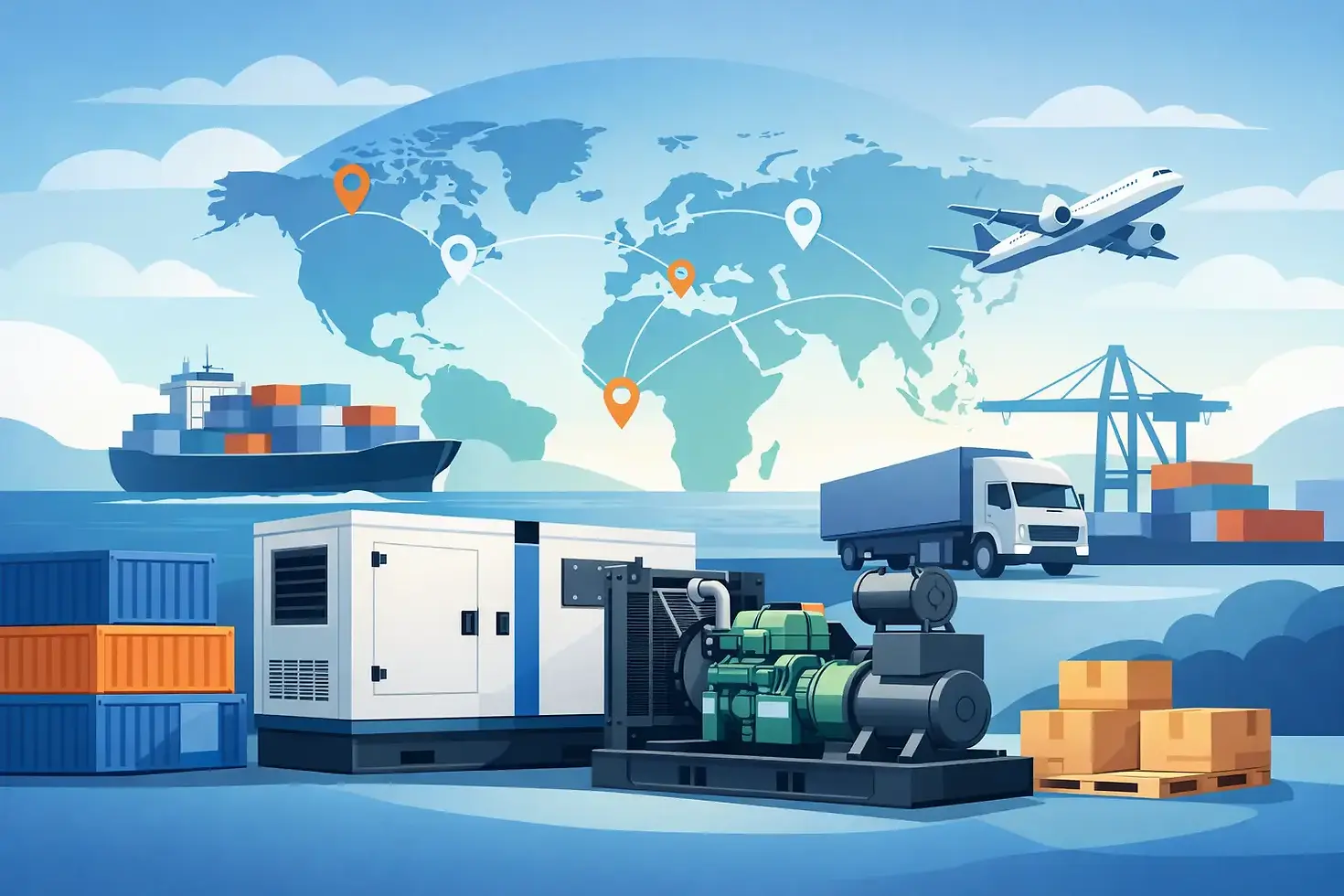
50Hz Generators for Export in Global Service

A generator can be correctly sized in kilowatts and still be wrong for the job. For international deployments, 50Hz generators for export must match the local electrical frequency, voltage, grounding method, connection hardware, fuel conditions, and operating environment before they leave the yard. A 500 kW unit that cannot integrate with the site distribution system is not a power solution. It is an expensive delay at the port or project site.
Export buyers need more than a diesel generator set. They need a complete, supportable power package that can be commissioned quickly and maintained where it will operate. That requirement applies whether the equipment is headed to a manufacturing facility, a remote mine, a marine terminal, a telecommunications installation, a municipal utility project, or a temporary construction site.
Specifying 50Hz Generators for Export
The first requirement is frequency. Much of the United States operates on 60 Hz, while many international markets use 50 Hz. Frequency affects engine speed, alternator configuration, motor performance, and downstream equipment compatibility. A generator built for 50 Hz typically operates at 1,500 RPM with a four-pole alternator, rather than the 1,800 RPM configuration commonly used for 60 Hz power.
Frequency alone does not complete the specification. Voltage must be selected for the country, facility, and connected load. Common export configurations include 400/230V, 415/240V, and 380/220V three-phase systems, although requirements vary by region and site. Some projects require medium-voltage generation with transformers and switchgear. Others need low-voltage power distributed through panelboards, bulk cable, and temporary distribution equipment.
Procurement teams should establish the required voltage, phase, wire configuration, grounding approach, and connection type before requesting a quote. This prevents a common field problem: the generator arrives with adequate capacity, but the output configuration does not match the building service, transfer switch, or equipment fleet.
Confirm the actual load, not only the nameplate total
Generator capacity should be based on a load study, including starting currents, step loads, harmonic-producing equipment, power factor, and expected future expansion. Pumps, compressors, crushers, conveyors, cranes, and large motor loads can create substantial voltage dip during startup. Variable-frequency drives, UPS systems, and sensitive controls may require careful alternator and control selection as well.
A standby facility load may allow a different sizing approach than a prime-power mining camp or a continuous industrial process. Prime-rated applications require equipment intended to carry varying load for extended operating hours. Standby systems are designed for emergency use and should not be treated as a substitute for continuous-duty power. The rating must match the operating profile, not simply the lowest initial purchase price.
Build the Export Package Around Site Conditions
A generator set is only one part of a working power system. Export projects often fail during planning because accessory equipment is treated as an afterthought. The right package depends on site logistics, fuel availability, weather exposure, local service capability, and whether the generator is stationary, trailer-mounted, containerized, or installed in a purpose-built power room.
For remote and high-demand applications, the package may include a weatherproof or sound-attenuated enclosure, base or remote fuel tank, fuel transfer pumps, filtration equipment, battery charger, block heater, distribution panel, automatic transfer switch, paralleling controls, and step-up or step-down transformer. A rental installation may need temporary cables, cam-lock connections, load banks, and portable distribution. A permanent site may require engineered switchgear, remote monitoring, and a larger bulk fuel system.
Ambient conditions matter. High altitude, extreme heat, high humidity, salt exposure, airborne dust, and poor fuel quality can all affect generator performance and service intervals. Engine derating at altitude and elevated temperature should be calculated before finalizing capacity. Coastal and marine-adjacent locations may require corrosion-resistant components and enclosure protection. Dust-heavy mining and quarry sites need filtration and maintenance access that match the operating environment.
Fuel strategy should be decided before shipment
Diesel remains a practical choice for many export applications because fuel storage and refueling can be managed independently of utility availability. However, fuel quality varies across regions. Water contamination, microbial growth, and particulate contamination can damage injectors and shorten component life. Fuel polishing systems, water separation, tank filtration, and properly sized storage are operational safeguards, not optional extras for long-duration installations.
Natural gas and gaseous generator packages can be effective where fuel infrastructure is stable and gas quality is known. They may not be the right answer for remote sites with uncertain pipeline supply or limited local technical support. The fuel source should be evaluated against runtime requirements, delivery access, emissions requirements, and the consequences of an interruption.
Controls, Synchronization, and Transfer Requirements
A basic manual-start generator may serve a simple temporary load. Critical facilities generally need more. Automatic transfer switches start the generator and transfer the load after utility failure. Paralleling switchgear allows multiple generators to share load, provides redundancy, and can support staged capacity growth. Load management controls can prioritize essential equipment when available generation is limited.
For export applications, confirm the control language, metering requirements, communications protocol, and remote-monitoring needs. A controls package that works well for a domestic installation may need different configuration for a facility using regional standards or an existing building-management system. If the unit will operate in parallel with utility power or other generators, protection settings and synchronization requirements must be reviewed at the engineering stage.
The simplest package is not always the fastest to deploy. A slightly more complete controls and distribution scope can reduce site fabrication, commissioning time, and troubleshooting after arrival.
Documentation and Shipping Are Part of Equipment Readiness
International procurement requires accurate commercial and technical documentation. Buyers should verify serial numbers, equipment descriptions, weights, dimensions, packing details, country-of-origin requirements, and any inspections or certificates needed for the destination. Documentation must describe the actual supplied configuration, including enclosure, fuel tank, accessories, and loose-shipped components.
Shipping preparation also deserves attention. Large generator sets may require skid protection, export crating for controls and accessories, container loading plans, lifting points, drain-down procedures, battery handling, and preservation for long transit periods. A generator that sits in humid port storage or crosses an ocean without proper preparation can arrive with avoidable battery, fuel, or moisture-related issues.
Lead time is another practical factor. New equipment may be the correct choice when the project requires a precise engine platform, emissions package, voltage configuration, or warranty path. Remanufactured and pre-owned equipment can shorten procurement time or control capital cost when condition, runtime history, load-bank testing, and parts availability are properly reviewed. The right option depends on the site schedule and the cost of delayed energization.
Parts and Service Planning Protect Uptime
The generator purchase is the beginning of the operating cycle. Before export, identify the consumables and service components that should travel with the unit: filters, belts, hoses, coolant, sensors, breakers, controller components, and commonly replaced engine parts. The recommended spare-parts scope will differ for a short project deployment and a remote installation expected to operate for years.
Local technician capability should influence equipment selection. A globally supported engine and controller platform may offer practical advantages in a region where replacement parts and trained service personnel are available. Conversely, highly specialized equipment can create downtime risk if every repair depends on international freight.
Atlantic Power & Equipment can source 50 Hz power systems from 25 kW through 4,000 kW and larger, along with transfer switches, transformers, fuel systems, cable, distribution equipment, and replacement components. A complete quote should identify the generator rating, frequency, voltage, enclosure, tank, controls, accessories, and shipment scope so the receiving team knows exactly what is arriving.
The strongest export generator package is the one that reaches the site ready to connect, ready to carry the real load, and supported with the parts and infrastructure required to keep it running.


