


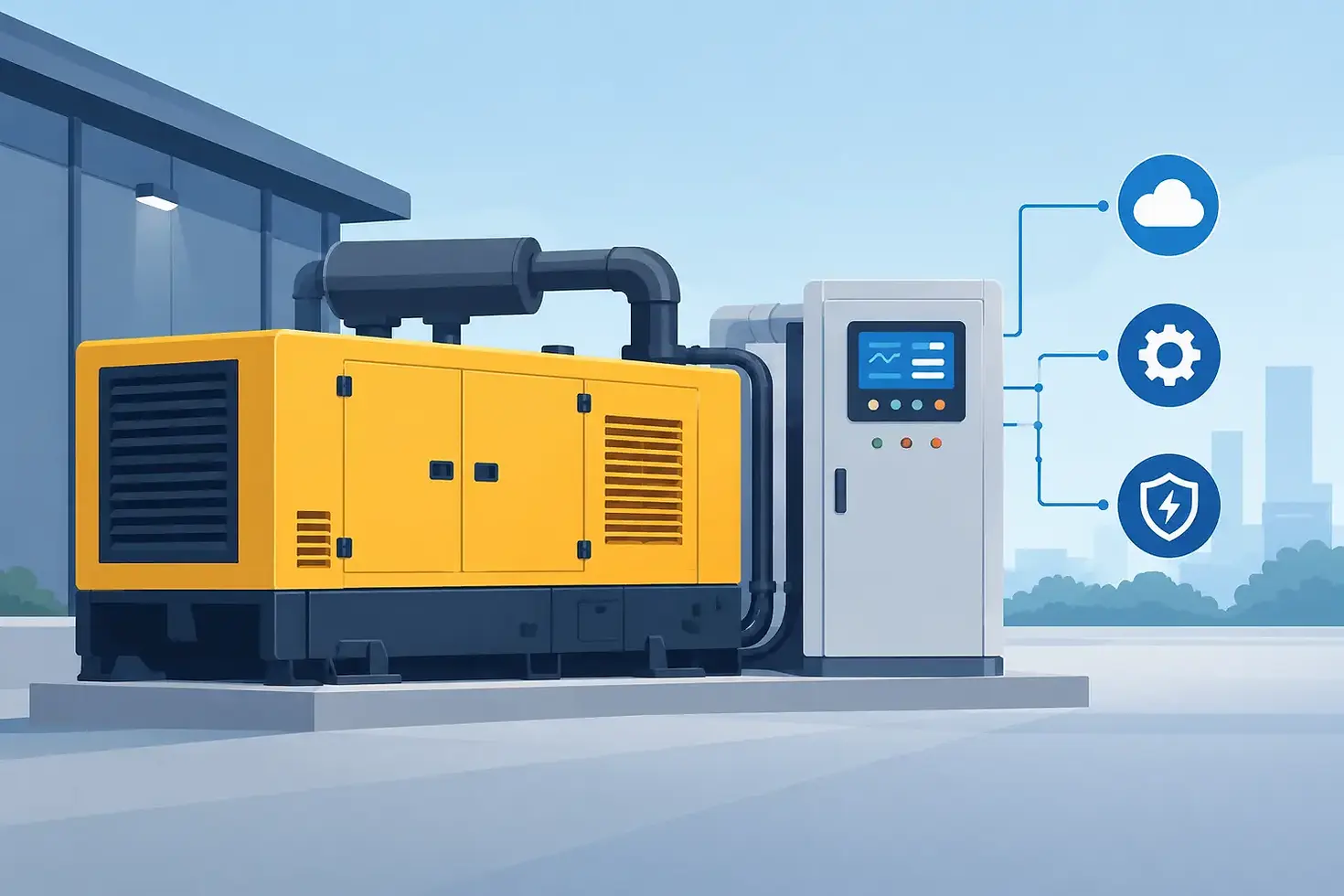
Generator Automation for Critical Power Systems

A standby generator that starts but does not transfer the load is not a backup-power solution. Neither is a unit that transfers successfully but operates with low fuel, an alarm condition, or an overloaded feeder. Generator automation connects the equipment and control logic that turns separate assets - generator sets, transfer switches, switchgear, fuel systems, and distribution - into a coordinated power system.
For facilities where an outage affects safety, production, communications, water service, refrigeration, or revenue, automation is an operational requirement. The correct system must start the right generators, move the right loads, protect the equipment, and provide operators with usable information when normal power is unavailable.
What Generator Automation Controls
Generator automation is the control layer between utility power, on-site generation, and connected loads. At its simplest, an automatic transfer switch detects a utility failure, signals the generator to start, waits for acceptable voltage and frequency, then transfers the designated load to emergency power. When normal utility power returns and stabilizes, the switch transfers the load back and allows the generator to complete its cooldown cycle.
That basic sequence works for a small commercial building with one generator and one essential-load panel. Larger systems require more control. A hospital, industrial plant, municipal pumping station, data facility, marine operation, or construction site may need multiple generators, multiple transfer switches, utility paralleling, load shedding, remote annunciation, or automated fuel management.
The automation package may include generator-mounted controls, automatic transfer switches, paralleling switchgear, protective relays, programmable controllers, communications gateways, and supervisory monitoring. Each component has a separate job. Together, they determine how the power system behaves during normal operation, an outage, a generator fault, and restoration.
Generator Automation Must Match the Load Strategy
The first question is not which controller to buy. It is which loads must remain energized, how quickly they must be restored, and what happens if available generation is limited.
Life-safety loads, fire pumps, emergency lighting, controls, and critical communications may require priority restoration. Process equipment can require a planned sequence to prevent a large inrush load from pulling generator voltage or frequency below acceptable limits. In other applications, a facility may need only selected loads supported long enough for an orderly shutdown.
A well-designed automation sequence assigns priorities. It may start with essential loads, then add secondary loads after the generator reaches stable operating conditions. If the system approaches its capacity limit, load-shed controls can disconnect noncritical circuits before the generator trips on overload. When capacity returns, the system can reconnect those loads in stages.
This is why generator rating alone does not define backup capability. A 1,000 kW generator can still underperform if the transfer scheme applies the entire load at once, motor starting was not evaluated, or fuel delivery cannot support the expected runtime. Automation must be specified alongside generator capacity, voltage, distribution, and fuel requirements.
Single-Generator Systems
For many facilities, a single diesel or gaseous generator with an automatic transfer switch is the correct answer. The design is relatively direct, with fewer points of failure and lower initial equipment cost. It is commonly used for retail facilities, smaller manufacturing operations, municipal buildings, telecom sites, and temporary power applications.
The trade-off is lack of redundancy. If that one generator is unavailable for maintenance or experiences a fault during an outage, there is no alternate source. Buyers should also confirm that the transfer switch rating, breaker coordination, cable sizing, and fuel storage match the generator and connected load.
Paralleling and Multiple-Generator Systems
Multiple-generator systems provide capacity growth, redundancy, and improved efficiency when loads vary substantially. Paralleling controls synchronize generator voltage, frequency, and phase angle before closing generators onto a common bus. The system can then distribute kW and kVAR loading across available units.
Automation can start only the number of generator sets needed for the current demand. That reduces unnecessary engine runtime and may keep operating units within a more favorable load range. If one unit faults, remaining units can continue serving priority loads if sufficient capacity is available.
Paralleling adds capability, but it also adds engineering and commissioning requirements. Protective settings, breaker logic, synchronization, load-sharing controls, and utility interconnection rules must be verified as a complete system. It is not a plug-and-play upgrade to a standard standby installation.
Transfer Switches Are a Core Automation Component
Automatic transfer switches are often treated as accessories. In practice, they are central to how the emergency power system responds. The transfer switch must be selected for the application voltage, amperage, available fault current, switching duty, and load type.
Open-transition transfer switches briefly disconnect the load before connecting the alternate source. They are common and cost-effective for many standby applications. Closed-transition transfer systems can transfer with momentary source overlap when the utility and generator are synchronized, reducing interruption for sensitive operations. Bypass-isolation transfer switches allow service or testing of the transfer equipment while maintaining a path for power, a major benefit where downtime is difficult to schedule.
For facilities with several transfer switches, automation must prevent all loads from starting simultaneously unless the generator system was specifically sized for that event. Time delays, priority controls, and staged loading are practical tools for protecting both the generator and the operation.
Monitoring Is Not the Same as Automation
Remote monitoring gives personnel visibility into generator status, alarms, fuel level, battery voltage, run hours, and operating parameters. That visibility is valuable, especially for unattended sites or fleets across multiple locations. But monitoring alone does not perform automatic transfer, load shedding, generator paralleling, or protective actions.
The strongest approach combines both functions. Automation executes a defined response without waiting for an operator. Monitoring records what occurred and alerts the right personnel when attention is required. Event logs are particularly useful after an outage because they show whether the generator received a start signal, reached rated speed, accepted load, experienced an alarm, or failed during transfer.
For remote sites, communications design matters. Cellular, Ethernet, radio, or facility network connections may be appropriate depending on location and security requirements. The control system should also remain useful if the monitoring connection fails. Local automatic operation cannot depend on a remote communications path.
Fuel Systems Need Automated Protection
A generator cannot deliver power without usable fuel. For diesel systems, automation can monitor day-tank levels, activate transfer pumps, alarm on high or low levels, and identify abnormal fuel conditions. Larger installations may require bulk storage, redundant pumps, fuel polishing equipment, filtration, and controls that prevent overfill or dry-run conditions.
Fuel quality is a long-term reliability issue, especially for standby systems that run infrequently. Water, sediment, microbial growth, and degraded fuel can block filters or damage injection components precisely when emergency power is needed. Automated alarms help identify conditions early, but scheduled fuel testing, polishing, and filter service remain necessary.
Gaseous generator systems have different constraints. Natural gas pressure, propane storage, vaporization capacity, and fuel supply reliability must be evaluated against the full expected load. The automation logic may be correct, but inadequate fuel pressure will still prevent the engine from carrying the load.
Commissioning Proves the Sequence Works
Generator automation should be tested as an operating system, not just as individual equipment. A no-load exercise verifies that the engine starts, but it does not prove the transfer switch, distribution equipment, load priorities, fuel system, or protection settings will perform under actual conditions.
Commissioning should verify utility-loss sensing, generator start timing, voltage and frequency acceptance, transfer operation, staged loading, alarm reporting, load shedding, retransfer, cooldown, and shutdown. For paralleling systems, testing should also confirm synchronization, load sharing, generator priority, breaker operation, and response to a unit failure.
Periodic load-bank testing can validate generator output where facility testing is impractical. However, a load bank does not duplicate every site condition. The best maintenance program uses both equipment-level testing and planned live transfer testing when the operation can support it.
Specify the System as One Package
A generator, transfer switch, fuel tank, distribution section, and control panel can be purchased separately, but they must operate as one engineered package. Specify the available utility service, voltage, load profile, motor loads, required runtime, fuel type, transfer requirements, future expansion, communications needs, and maintenance access before equipment is selected.
Atlantic Power & Equipment supplies generator sets from 25 kW through 4,000 kW and larger, along with transfer switches, power distribution equipment, transformers, bulk cable, fuel tanks, refueling systems, filtration products, and related components. For new, remanufactured, or pre-owned equipment, the objective is the same: source a power system that can respond predictably when the utility does not.
The right automation design is not the one with the most screens or the longest feature list. It is the one that starts, transfers, protects, communicates, and restores power according to the actual priorities of the operation.


