


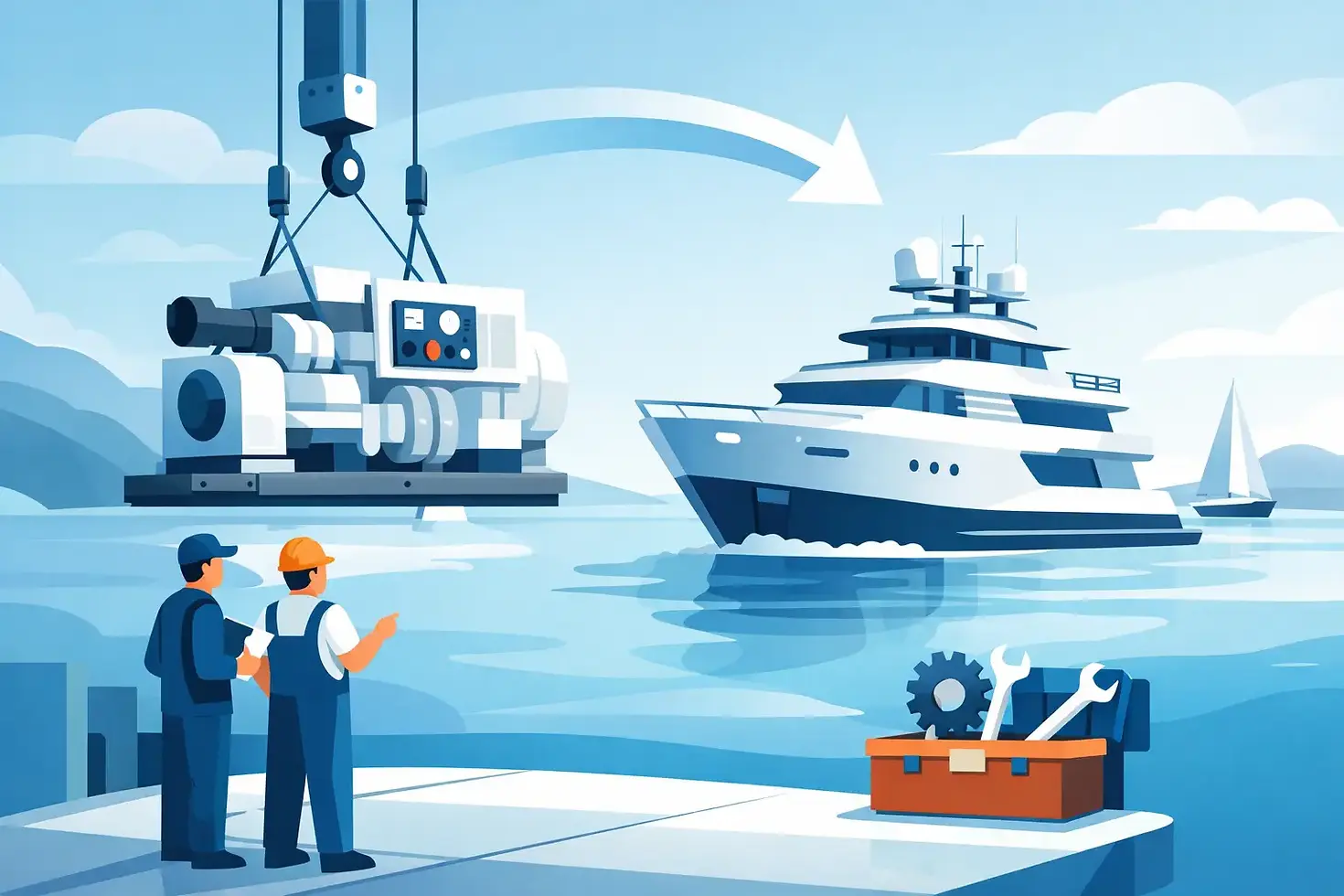
Marine Generator Replacement Guide for Uptime

A marine generator rarely fails at a convenient time. It fails during a charter, alongside a remote worksite, during a storm season, or when a vessel’s hotel loads are already near their limit. This marine generator replacement guide is built for owners, fleet managers, and technical buyers who need to replace an aging genset without creating new problems in the electrical system, engine room, or maintenance schedule.
The correct replacement is not always a like-for-like kilowatt swap. Physical access, frequency, voltage, emissions requirements, cooling arrangement, load profile, sound levels, fuel quality, and service-part availability all affect the final specification. Treat replacement as a power-system decision, not simply an engine purchase.
Start With the Real Reason for Replacement
Before requesting quotes, define whether the existing generator is worn out, undersized, unreliable, noncompliant, or no longer economical to maintain. A unit with declining insulation resistance, repeated overheating, excessive oil consumption, unstable voltage, or chronic control faults may be a replacement candidate even if it still starts.
Operating hours matter, but they do not tell the full story. A lightly used generator exposed to salt air, poor ventilation, wet stacking, or irregular maintenance can be in worse condition than a higher-hour unit with documented service. Review oil analysis, coolant condition, load-bank results, electrical test records, fuel consumption, and the history of unscheduled outages.
Replacement can also be justified by operating cost. An oversized diesel generator running at light load will often accumulate carbon, consume more fuel than necessary, and require more frequent corrective work. Conversely, a generator that constantly operates near its maximum rating may experience high temperatures, voltage dips, and limited reserve for pumps, compressors, or transient loads.
Marine Generator Replacement Guide: Size the Load First
Do not select a new generator from the nameplate rating of the old one alone. Build a current load study based on what the vessel actually operates. Separate continuous loads from intermittent loads and identify the largest motor starts or block loads.
Typical continuous demand may include navigation electronics, lighting, galley equipment, HVAC, refrigeration, pumps, communications, battery chargers, and accommodation loads. Intermittent demand can include bow thrusters, deck machinery, large chilled-water compressors, fire pumps, and workshop equipment. Some loads may not run together, while others become critical during docking, cargo operations, or emergency conditions.
Record both kW and kVA. Generator ratings are commonly expressed in kW, while alternator capacity and certain loads are affected by power factor. Poor power factor, variable-frequency drives, harmonic distortion, and large motor starting currents can require a larger alternator or a generator package designed for demanding electrical loads.
For many diesel generators, the most efficient operating range is generally well above idle load and below continuous maximum output. Exact targets depend on the engine, duty rating, and operating pattern, but a replacement should have enough capacity for expected demand plus practical reserve without spending most of its life lightly loaded. Where vessel loads vary widely, two smaller synchronized units may provide better fuel economy and redundancy than one large unit.
Confirm Frequency, Voltage, and Phase
A 60 Hz, 480V, three-phase generator is not interchangeable with a 50 Hz, 400V, three-phase package simply because the kW rating is similar. Verify vessel frequency, voltage, phase, grounding arrangement, transformer requirements, shore-power interfaces, and any parallel or load-sharing controls.
Frequency is tied directly to engine speed on conventional sets. A 60 Hz four-pole generator normally operates at 1,800 rpm, while a 50 Hz four-pole unit normally operates at 1,500 rpm. Changing frequency can affect motors, pumps, refrigeration equipment, controls, and connected auxiliary systems. Avoid assumptions and confirm every major load before approving the configuration.
Match the Generator to the Vessel Environment
Marine service places different demands on equipment than land-based standby power. Saltwater exposure, vibration, confined engine rooms, high ambient temperatures, vessel motion, and restricted maintenance access all shape the right package.
Cooling is a primary decision. Keel-cooled, heat-exchanger-cooled, and radiator-cooled generators each have different installation requirements. A heat-exchanger system may fit a vessel already using raw-water circuits, but it requires dependable seawater flow, properly sized strainers, corrosion control, and service access. Keel cooling reduces seawater-side maintenance but requires hull-side engineering and adequate heat rejection. Radiator packages are typically impractical below deck unless the ventilation system is designed for the heat load.
Physical dimensions must include more than the generator skid. Measure the engine room opening, removal path, overhead clearance, vibration mounts, exhaust routing, fuel connections, coolant piping, service-side access, and control-panel visibility. A unit that fits on a drawing can still become an expensive problem if filters, injectors, belts, or heat exchangers cannot be reached after installation.
Noise and vibration deserve attention on passenger vessels, yachts, research platforms, and accommodation barges. Specify marine-rated mounts, a properly sized exhaust silencer, flexible connections, and sound attenuation appropriate to the vessel’s use. Excessive vibration can damage wiring, fuel lines, exhaust joints, and controls long before it becomes an obvious comfort issue.
Specify the Complete Replacement Package
A generator set is one part of a working power system. A sound replacement scope identifies the supporting equipment that must be reused, upgraded, or replaced at the same time.
At minimum, review the following components:
Main breaker rating, interrupting capacity, and coordination with downstream protection
Automatic transfer switches, paralleling gear, synchronizing controls, and load-sharing logic
Fuel supply, return lines, day tanks, lift pumps, filtration, water separation, and fuel-polishing equipment
Exhaust piping, insulation, flexible sections, silencer condition, backpressure, and wet-exhaust components where applicable
Starting batteries, chargers, cabling, emergency shutdowns, alarms, and remote monitoring
Ventilation air, combustion air, heat rejection, and engine-room temperature under full load
Do not assume existing switchgear will accept the new generator’s control system. Modern digital controllers can improve diagnostics and remote visibility, but integration with legacy alarms, vessel management systems, or paralleling equipment may require additional interface hardware and programming.
Fuel quality is another frequent cause of avoidable trouble. If the existing system has contamination, microbial growth, water intrusion, or degraded tanks, a new generator will inherit the same failure risk. Address tank cleaning, filtration, and polishing before commissioning the replacement set.
Choose New, Remanufactured, or Pre-Owned Equipment Carefully
The best procurement path depends on schedule, budget, duty cycle, and the availability of qualified service support. New equipment provides current controls, factory warranty options, and a known service history from day one. It is often the right choice for mission-critical propulsion support, commercial operations, and vessels facing long service intervals.
Remanufactured equipment can be a practical option when the platform is proven, the rebuild scope is documented, and the engine and alternator are supported with available parts. Review what “remanufactured” means in the actual scope. A complete, tested package with rebuilt major assemblies is different from a used unit with limited repairs.
Pre-owned marine generators can reduce acquisition time and capital cost, especially for temporary power, lower-duty applications, or urgent replacement projects. Require operating-hour verification, maintenance history when available, inspection of the alternator and engine, load testing, and confirmation that replacement filters, injectors, controls, and cooling components can still be sourced.
Atlantic Power & Equipment can support quote-based sourcing across New, Remanufactured, and Pre-Owned power-generation equipment, helping buyers compare available generator packages against vessel requirements and delivery schedules.
Plan the Installation and Commissioning Window
A replacement project succeeds or fails during planning. Order equipment early enough to account for factory build time, freight, vessel access, crane requirements, yard availability, fabrication, and electrical integration. Offshore and remote vessels should also account for spare parts, field-service travel, and weather-related schedule risk.
Before startup, verify fuel supply and return flow, cooling-water integrity, exhaust backpressure, battery capacity, grounding, phase rotation, breaker settings, alarm functions, and emergency shutdown circuits. Then commission the generator under controlled load, not only at no-load idle. A load bank or documented vessel-load test confirms voltage regulation, frequency stability, temperature control, load acceptance, and proper transfer or parallel operation.
Capture baseline readings at commissioning: oil pressure, coolant temperature, exhaust temperature where monitored, voltage, frequency, kW, kVA, power factor, fuel consumption, and vibration. Those numbers become the reference point for future maintenance decisions.
A marine generator replacement should leave the vessel with more than a new engine and alternator. It should leave operators with verified capacity, accessible service points, clean fuel, documented settings, and a power system ready for the next operating demand.


