


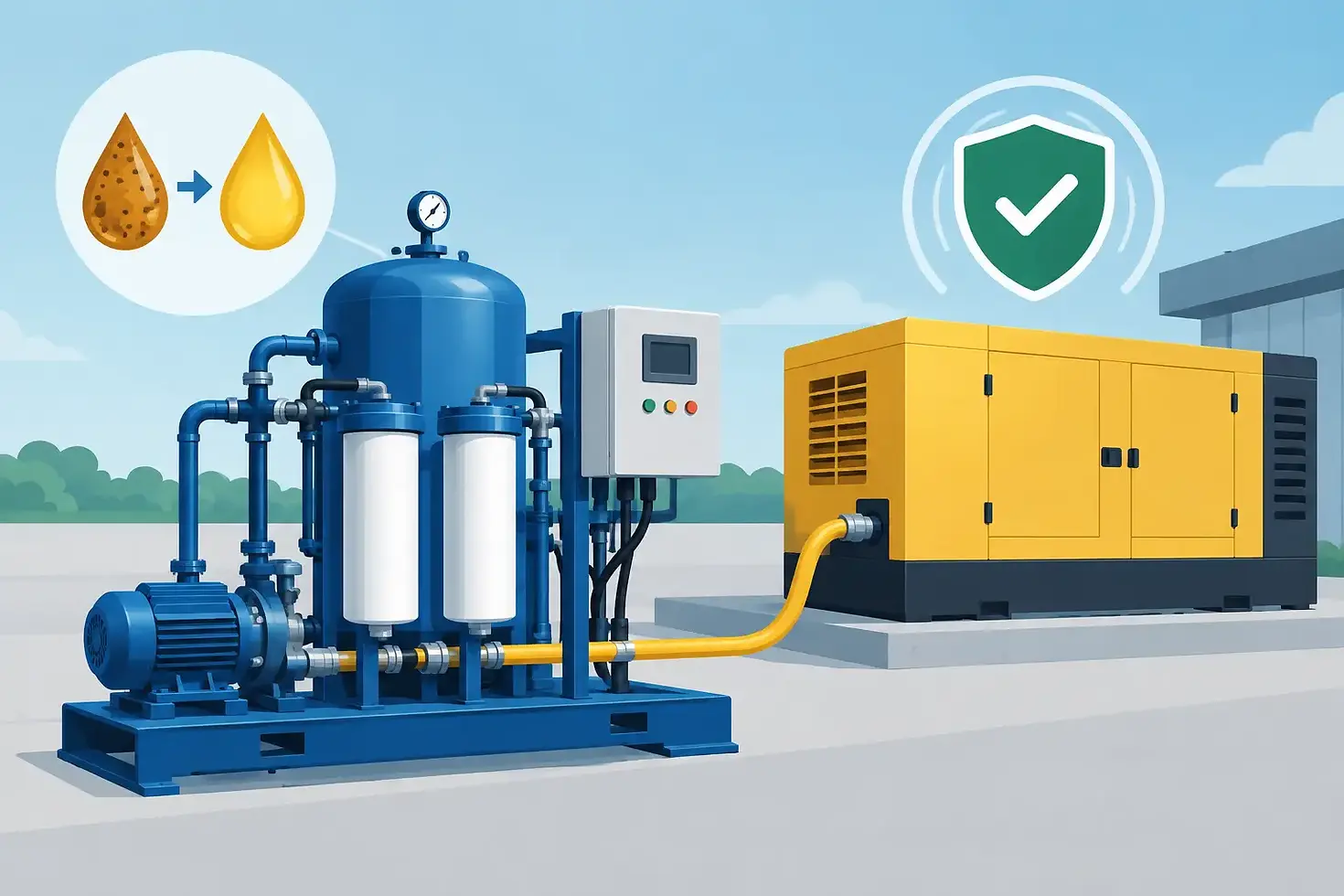
Fuel Polishers That Protect Generator Uptime

A standby generator can have a fully charged starting system, a tested transfer switch, and an adequately sized fuel tank, yet still fail when the load arrives. The weak point is often the fuel itself. Fuel polishers remove water, sediment, oxidation byproducts, and microbial contamination from stored diesel before those contaminants reach injectors, filters, and fuel-system components.
For facilities that depend on emergency power, stored fuel is not a passive reserve. It is a maintenance item. Hospitals, water plants, data facilities, industrial sites, marine operators, municipalities, and remote work sites all face the same operational risk: diesel can degrade while the equipment it supports sits idle. A properly selected fuel-polishing system keeps the reserve ready for service instead of leaving its condition to chance.
Why Stored Diesel Creates a Uptime Risk
Diesel fuel changes over time. Temperature swings pull moisture into tank headspace through condensation. Water settles to low points, where it supports microbial growth and corrosion. Dirt can enter during deliveries, tank venting, and refueling. Fuel oxidation may create gums and dark particulate matter, particularly when fuel remains in storage for extended periods.
A generator may run successfully during a brief monthly exercise and still have a contaminated tank. Short run periods do not necessarily circulate the full tank volume, and the generator's onboard filtration is designed to protect the engine during operation, not to restore a large bulk fuel supply. By the time a restriction alarm, injector issue, or fuel-transfer problem appears, the failure may already be affecting standby readiness.
The consequences extend beyond a no-start condition. Contaminated fuel can plug primary and secondary filters, damage injection equipment, reduce engine performance, accelerate tank corrosion, and create repeated service calls. On large generator installations, a single extended outage can make the cost of proactive fuel maintenance look minor.
What Fuel Polishers Actually Do
Fuel polishers are dedicated recirculation systems that draw diesel from a storage tank, process it through staged filtration and water separation, then return clean fuel to the tank. Unlike a simple transfer pump, a polishing system is built to clean the entire stored volume on a planned cycle or on demand.
Most systems use a combination of water separation and particulate filtration. The exact arrangement depends on the equipment, fuel condition, and cleanliness target. A common setup includes a coarse pre-filter, a water-separating stage, and a finer final filter. Some packages add automatic water drains, tank-level interfaces, pressure monitoring, programmable controls, and remote alarm capability.
Polishing is not a substitute for correcting a severely compromised tank. If a tank contains substantial sludge, corrosion scale, or a heavy microbial infestation, the right response may include tank cleaning, fuel treatment, bottom-water removal, and replacement fuel. The polisher then becomes the ongoing maintenance tool that helps prevent the problem from returning.
Water Removal Is the First Priority
Water is the condition that allows many fuel problems to compound. Free water at the bottom of a tank promotes microbial activity at the fuel-water interface. It also contributes to rust in steel tanks and can be drawn into the fuel stream during demand events or aggressive fuel transfer.
An effective system needs a water-separation method appropriate for diesel fuel and expected flow rate. Automatic water evacuation can reduce routine labor, but it should be matched with proper containment and inspection procedures. Operators still need to verify what is being removed and investigate recurring water accumulation rather than simply draining it indefinitely.
Filtration Must Match the Application
Filter micron ratings are not a universal specification. Finer filtration can improve fuel cleanliness, but it may also create higher pressure drop and more frequent filter changes when fuel is heavily contaminated. A system intended to maintain clean fuel in a well-managed generator tank can be configured differently than a portable unit used to recover questionable fuel from multiple jobsite tanks.
Flow rate matters as well. Higher flow is not automatically better. A large tank requires enough capacity to turn over its volume within the maintenance window, while allowing adequate contact time for separation and filtration. The practical selection point is total tank capacity, desired polishing interval, fuel condition, and available operating time.
Selecting Fuel Polishers for the Job
Start with the fuel inventory and the consequence of failure. A 300-gallon day tank feeding a small standby unit does not require the same package as a 20,000-gallon bulk tank supporting multiple generators. The largest tank is not always the only concern. Day tanks, belly tanks, remote bulk storage, and transfer systems all need to be considered as one fuel-management system.
For permanent generator installations, a skid-mounted or wall-mounted automatic system can run on a programmed schedule and provide alarms for filter restriction, water detection, pump status, or abnormal conditions. This approach fits critical sites where staff need documented maintenance activity and early warning before an emergency.
Portable fuel polishers provide flexibility for contractors, fleet operations, marine applications, equipment yards, and facilities with several separate tanks. They can be moved where needed for corrective work, new fuel acceptance, tank-to-tank transfer support, or periodic maintenance. The trade-off is that portable equipment requires operator time, hose management, and disciplined scheduling.
When evaluating a package, confirm the required duty cycle, electrical supply, pump compatibility, hose and connection requirements, filtration stages, control options, and service access. Outdoor installations also require attention to enclosure rating, temperature exposure, and protection from physical damage. For hazardous or regulated locations, confirm that the selected equipment and installation method meet site requirements.
Build Polishing Into the Fuel Maintenance Plan
Fuel polishing works best as part of a defined program rather than an emergency response. Establish a sampling schedule, inspect tanks for water and sediment, document filter changes, and record fuel condition over time. Sampling should be drawn from representative locations, including tank bottoms where water and contamination settle.
Maintenance intervals depend on tank design, fuel turnover, climate, delivery practices, and operating environment. A frequently used prime-power tank may have different risks than a standby tank holding fuel for long periods. Facilities with high humidity, significant temperature changes, older tanks, or known water intrusion often need closer inspection.
Fuel treatment can have a place in the program, but additives do not remove contamination already in the tank. Biocides address microbial activity when correctly selected and applied, while stabilizers may help manage oxidation during storage. Neither replaces water removal, filtration, and physical tank cleaning where needed. Chemical treatment should be based on testing and the fuel supplier's guidance, not used as a blanket fix.
The delivery process deserves attention, too. Verify incoming fuel quality, use controlled fill procedures, inspect caps and vents, and keep water from entering during refueling. A polishing system can maintain fuel quality, but it should not be expected to compensate for poor delivery or tank-management practices.
Common Mistakes That Undercut Fuel Readiness
The first mistake is relying solely on generator exercise runs. Exercising the engine proves portions of the generator system, but it does not confirm the cleanliness of the full stored fuel volume. The second is treating clogged filters as a normal maintenance issue without identifying the contaminant source. Replacing filters repeatedly can mask water intrusion, microbial growth, or deteriorating tank conditions.
Another common issue is undersizing the system. A low-flow unit may technically work but require so many hours to cycle a large tank that it is rarely operated long enough to be effective. Conversely, an oversized package can add unnecessary cost and may not improve separation performance if the filtration arrangement is not suited to the application.
Finally, do not install a polisher and forget it. Inspect hoses, fittings, pumps, filter housings, controls, and drains. Confirm that returned fuel is routed correctly and that the system can access the portions of the tank where contamination collects. A well-designed unit is only useful when it is maintained and actually placed into service.
Atlantic Power & Equipment supplies fuel-polishing equipment alongside generators, fuel tanks, refueling systems, filtration products, and backup-power infrastructure. That broader equipment view matters when the issue is not just a filter skid, but the reliability of the complete fuel path from bulk storage to generator engine.
A clean fuel reserve is a controllable part of standby-power readiness. Specify the fuel-polishing capacity around the tank, the duty cycle around the operation, and the maintenance plan around the real cost of an outage.


